

The best brands do not just watch competitors. They anticipate moves by reading pricing patterns like a strategic roadmap.
That distinction matters. A price change is rarely just a price change. It can reveal where a competitor feels pressure, which categories they want to defend, where they have excess inventory, which products they are using to win traffic, and how confident they are in their brand position.
For years, price monitoring was treated as a tactical ecommerce job. Someone checked competitor websites, built a spreadsheet, and reacted when a rival dropped prices. That approach still has a place, but it no longer gives brand managers, marketing directors, and strategic planners enough context.
Modern competitive intelligence is less about asking, “Are we cheaper?” and more about asking, “What is this competitor trying to do?”
That is where competitor price monitoring tools, brand positioning intelligence, market intelligence platforms, and competitor tracking software now overlap. The strongest tools do not simply collect price points. They help commercial teams understand patterns across entire product catalogues, reseller networks, regions, channels, and time.
This guide compares 10 tools that help brands monitor pricing, understand the market, and act with more confidence.
8 best competitor intelligence and price monitoring tools compared
- PriceShape
Best for strategic market intelligence across pricing, catalogues, competitors, brands, and historical market movement. - Minderest
Best for enterprise market monitoring across global ecommerce, marketplaces, and digital shelf data. - Omnia Retail
Best for retailers that need pricing automation connected to commercial rules and ecommerce workflows. - Prisync
Best for ecommerce teams that want fast competitor price tracking and dynamic repricing. - Price2Spy
Best for teams that need broad price monitoring, alerts, and reporting across many competitors. - Dealavo
Best for brands and retailers that need price monitoring across European ecommerce and marketplace channels. - Pricefy
Best for smaller teams that want accessible competitor tracking and repricing support. - Skuuudle
Best for retailers and brands that need structured competitive pricing data and product matching.
1. PriceShape
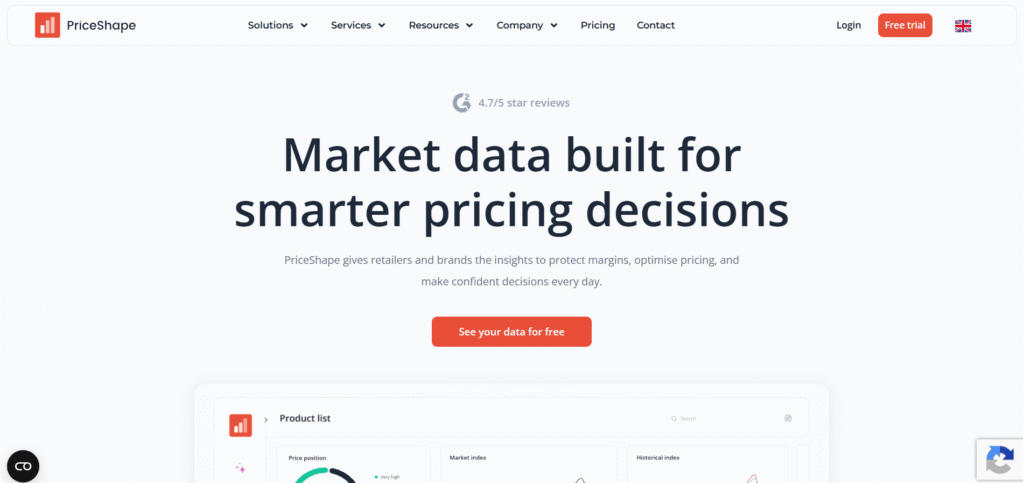
Best for: Brands, wholesalers, and retailers that want to understand competitor strategy through pricing patterns, not just monitor individual price changes.
Approach: Strategic market intelligence with pricing history, catalogue level tracking, brand insights, reseller visibility, dynamic pricing, marketplace data, and AI assisted analysis.
Price monitoring is useful. Market memory is more powerful.
That is the difference at the centre of this platform. It goes beyond price scraping by showing how prices, assortments, product availability, marketplace activity, and brand movements evolve over time. For strategic teams, that historical depth matters because a snapshot tells you what happened today, while pricing evolution shows how a competitor arrived there.
This makes PriceShape particularly useful for brand managers and marketing directors who need to understand positioning. A competitor’s price pattern often reveals more than their public campaigns. If a rival repeatedly cuts prices in a specific category, holds premium pricing in another, and expands reseller coverage in a third, you are looking at a strategic roadmap.
The platform tracks pricing across entire product catalogues, not only bestsellers. That is important because strategic moves often start outside the obvious products. A competitor testing lower prices on secondary SKUs, quietly expanding in adjacent categories, or changing reseller activity before a campaign launch gives brands an earlier signal than public announcements.
As a competitor price monitoring platform, it suits teams that care about depth over speed alone. Fast alerts help. Context changes decisions.
Key features:
- Historical pricing intelligence that shows market evolution, not isolated snapshots.
- Competitor and reseller monitoring across products, categories, and markets.
- Catalogue wide tracking for broader strategic visibility.
- Brand insights that show where brands are sold, which categories they cover, and who the leading retailers are.
- Dynamic pricing and rules for teams that want to connect insight with action.
- AI assisted analysis through Penny, designed to help teams ask pricing and market questions inside the platform.
- Marketplace and comparison engine visibility across channels such as Google Shopping, Amazon, Idealo, Bol, and Pricerunner.
Strategic use case:
Imagine a premium appliance brand sees a competitor discounting one product line across multiple retailers. A basic tracker flags the price drop. A stronger intelligence platform shows that the same competitor has increased assortment depth in that category, reduced prices gradually over six weeks, and held prices steady in its premium range.
That pattern suggests more than a promotion. It suggests a deliberate push to win share in a mid tier category while protecting premium positioning. The brand response is not simply to match the discount. The better response is to assess margin exposure, review channel incentives, protect flagship products, brief key account managers, and adjust paid media toward products where the brand can still defend value.
That is the strategic advantage. The data does not just answer, “What price are they charging?” It helps answer, “What are they trying to achieve?”
Pros:
- Strong fit for strategic planning, not only tactical repricing.
- Historical depth helps reveal long term pricing behaviour.
- Catalogue wide visibility exposes early competitive moves.
- Useful for brand positioning intelligence and reseller strategy.
- AI assisted analysis helps teams turn market data into clearer decisions.
Considerations:
- Better suited to teams that need advanced insight rather than entry level monitoring.
- The value increases when pricing, marketing, sales, and category teams use the data together.
2. Minderest
Best for: Larger retailers and brands that need international price, catalogue, and digital shelf visibility.
Approach: Market monitoring across ecommerce, marketplaces, retail channels, and product data.
Minderest is often considered by organisations that need broad coverage across regions and sales channels. It is relevant for teams managing large product ranges, international reseller networks, or complex pricing visibility across online and offline environments.
It supports use cases such as competitor price tracking, marketplace monitoring, assortment comparison, product availability analysis, and promotional visibility. For brands, this helps create a clearer picture of how products appear across the market and how competitors present similar ranges.
Key features:
- Price monitoring across multiple markets and retailers.
- Digital shelf visibility for product pages and availability.
- Competitor assortment and promotion tracking.
- Marketplace monitoring.
- Reporting for brand and retail teams.
Pros:
- Strong fit for companies with international market coverage.
- Useful for teams that need pricing and digital shelf visibility together.
- Relevant for brands managing complex reseller environments.
Considerations:
- Setup and configuration require planning when product catalogues and markets are large.
- Best results come from a clear internal view of which markets, competitors, and channels matter most.
3. Omnia Retail
Best for: Retailers that want pricing automation and commercial rules connected to ecommerce performance.
Approach: Dynamic pricing, pricing automation, and competitor data connected to retail strategy.
Omnia Retail is built around pricing automation for ecommerce teams. It helps retailers use competitor data, business rules, stock information, and margin targets to automate pricing decisions.
This makes it useful for teams that already have a clear pricing strategy and want to scale execution. Instead of manually changing prices product by product, teams set rules that guide automated pricing behaviour.
Key features:
- Dynamic pricing automation.
- Competitor price monitoring.
- Pricing rules based on margin, stock, and commercial goals.
- Ecommerce focused dashboards.
- Strategy based repricing workflows.
Pros:
- Strong fit for retail pricing teams.
- Helps automate repetitive pricing decisions.
- Useful when pricing rules are clearly defined.
Considerations:
- Most relevant for retailers rather than brand only teams.
- Strategic value depends on the quality of the rules and input data.
4. Prisync
Best for: Ecommerce teams that want practical competitor price monitoring and repricing.
Approach: Competitor tracking, product matching, alerts, and dynamic pricing features.
Prisync is a popular option for ecommerce businesses that need a direct way to track competitor prices and respond with pricing rules. It is often used by teams that want a clear dashboard, competitor alerts, and repricing support without building a complex system from scratch.
It works well for teams that need operational visibility. For example, a retailer can monitor selected competitors, review price changes, and apply rules to stay competitive while protecting margins.
Key features:
- Competitor price tracking.
- Stock availability monitoring.
- Dynamic repricing rules.
- Product matching.
- Reports and alerts.
Pros:
- Practical for ecommerce teams.
- Clear use case for price matching and repricing.
- Suitable for teams that want faster implementation.
Considerations:
- Best suited to operational pricing workflows.
- Strategic insight depends on how broadly the team tracks categories and competitors.
5. Price2Spy
Best for: Teams that need flexible competitor tracking, alerts, and reporting.
Approach: Price monitoring through product URLs, competitor tracking, reports, and integrations.
Price2Spy is a long standing option in the price monitoring space. It is useful for businesses that need to monitor competitor products across multiple sites and receive alerts when prices change.
The platform supports reporting, repricing, and integrations, which makes it relevant for teams with established ecommerce operations. Its flexibility is useful when teams have specific competitors or URLs they want to monitor.
Key features:
- Competitor price tracking.
- Price change alerts.
- Historical price reports.
- Repricing options.
- API and ecommerce integrations.
Pros:
- Flexible monitoring setup.
- Useful alerting and reporting.
- Suitable for a wide range of ecommerce teams.
Considerations:
- URL based tracking requires good product matching discipline.
- Strategic value improves when teams analyse trends, not only alerts.
6. Dealavo
Best for: Brands and retailers that need price monitoring across European ecommerce and marketplaces.
Approach: Price monitoring, repricing, product matching, and marketplace visibility.
Dealavo supports companies that want to monitor pricing across online stores and marketplaces. It is relevant for European teams managing price visibility across several countries, retailers, and platforms.
For brands, it helps track how products are priced by resellers. For retailers, it helps identify competitor moves and support price decisions.
Key features:
- Competitor price monitoring.
- Marketplace tracking.
- Repricing support.
- Product matching.
- Reports for brands and retailers.
Pros:
- Useful for European ecommerce monitoring.
- Supports brand and retailer use cases.
- Helps teams review market prices and reseller behaviour.
Considerations:
- Best results require careful competitor and marketplace selection.
- Teams should define whether the goal is tactical repricing, reseller oversight, or strategic market analysis.
7. Pricefy
Best for: Smaller ecommerce teams that want accessible price monitoring and repricing support.
Approach: Competitor tracking, marketplace monitoring, alerts, and pricing rules.
Pricefy is suited to businesses that want a more accessible way to monitor competitor prices and support repricing decisions. It offers a practical entry point for teams that need visibility but do not require a full strategic intelligence setup.
It is useful for smaller catalogues, lean ecommerce teams, and businesses that want to understand competitor pricing without a heavy process.
Key features:
- Competitor price tracking.
- Marketplace monitoring.
- Repricing simulator.
- Alerts.
- Dashboard reporting.
Pros:
- Accessible for smaller teams.
- Practical for day to day competitor tracking.
- Useful when pricing visibility is the first priority.
Considerations:
- Less suited to complex enterprise planning.
- Strategic analysis requires disciplined reporting and interpretation from the internal team.
8. Skuuudle
Best for: Retailers and brands that need structured competitive pricing data and product matching.
Approach: Product matching, price monitoring, data quality workflows, and reporting.
Skuuudle focuses on helping companies collect and structure competitor pricing data. It is often relevant for retailers and brands that need reliable product matching and consistent reporting across competitor ranges.
Its value is strongest when teams need clean data to support pricing reviews, category analysis, and commercial decisions.
Key features:
- Competitor price monitoring.
- Product matching.
- Data quality checks.
- Reporting dashboards.
- Market data support for pricing teams.
Pros:
- Strong focus on structured pricing data.
- Useful for teams that need matching accuracy.
- Relevant for category and pricing analysis.
Considerations:
- Setup depends on catalogue complexity.
- Teams need clear reporting goals to turn monitoring into action.
How to choose the right competitive intelligence stack
The best choice depends on the decision you want to improve.
If your team mainly needs alerts when competitors change prices, a focused tracking tool is enough.
If your ecommerce team needs automated price changes, choose a platform with dynamic pricing rules and repricing workflows.
If your brand team needs to understand positioning, channel behaviour, category pressure, and competitor strategy, choose a market intelligence platform with historical depth and catalogue wide visibility.
That final category is where the conversation changes. Brand managers and strategic planners are not only trying to win the next sale. They are trying to understand the market before the market becomes obvious.
A useful competitive intelligence stack answers five questions:
- Which competitors are changing prices?
- Which products and categories are affected?
- Is the movement temporary, seasonal, or part of a longer pattern?
- What does the pattern reveal about positioning, stock pressure, margin pressure, or category focus?
- What should pricing, sales, marketing, and account teams do next?
The more strategic the question, the more historical context matters.
Why pricing reveals competitor strategy
Pricing is one of the clearest public signals a competitor gives away.
A brand can control its messaging, campaign creative, product launches, and sales narrative. Pricing is harder to hide. Once prices move across retailers, marketplaces, and categories, the strategy starts to show.
A repeated discount pattern can reveal inventory pressure.
A premium range holding firm while entry level products fall can reveal segmentation strategy.
A sudden expansion of listings across marketplaces can reveal channel ambition.
A category wide price drop before peak season can reveal acquisition intent.
A reseller undercutting recommended prices can reveal channel conflict.
This is why the best brands do not stare at competitors obsessively. They build systems that detect meaningful movement and filter out noise.
The goal is not to chase every price change. The goal is to understand which price changes matter.
Final verdict
The market for competitor tracking software has split into two groups.
The first group helps teams monitor prices and react. These tools are useful, especially for ecommerce teams that need alerts, product matching, and repricing support.
The second group helps teams interpret the market. These platforms connect pricing data with history, assortment, reseller behaviour, marketplace movement, and brand positioning intelligence.
For brand managers, marketing directors, and strategic planners, the second group delivers the bigger advantage.
The strongest competitive intelligence stack does not make a team look obsessive. It makes the team better informed. It replaces reactive price checking with structured market understanding.
That is the real shift. Top brands no longer monitor pricing to copy competitors. They monitor pricing to understand strategy before it becomes visible elsewhere.

Adhya P. (She/Her) is an Influencer Marketing Executive and content writer at CreatorPunch with over 3 years of experience in digital marketing and campaign management. A Delhi University graduate, she is passionate about influencer marketing, content strategy, and helping brands build authentic connections through creative storytelling.